
The Quiet Disruption of Regulatory Convergence in Tokenised & Decentralised Finance
Regulatory convergence between private stablecoins, central bank digital currencies (CBDCs), and tokenised real-world assets could quietly reshape capital flows, industrial ecosystems, and governance models over the next two decades.
While narratives often focus on outright competition between CBDCs and stablecoins or on rapid scaling of tokenised assets, a less recognised but potent inflection is emerging: the gradual blending and regulatory harmonisation of traditionally siloed digital finance instruments into interoperable frameworks. This development may yield systemic shifts that restructure how value is issued, allocated, tracked, and regulated within both private and public spheres.
Signal Identification
This development qualifies as an emerging inflection indicator—an underappreciated pivot point visible primarily through regulatory evolution patterns rather than headline market valuations or technology alone. It is expected to materialise over a 10–20 year horizon with a medium to high plausibility, given current policymaker signals and institutional roadmap disclosures. The sectors most exposed include financial services, regulatory bodies, payments infrastructure, asset management, and digital identity governance.
What Is Changing
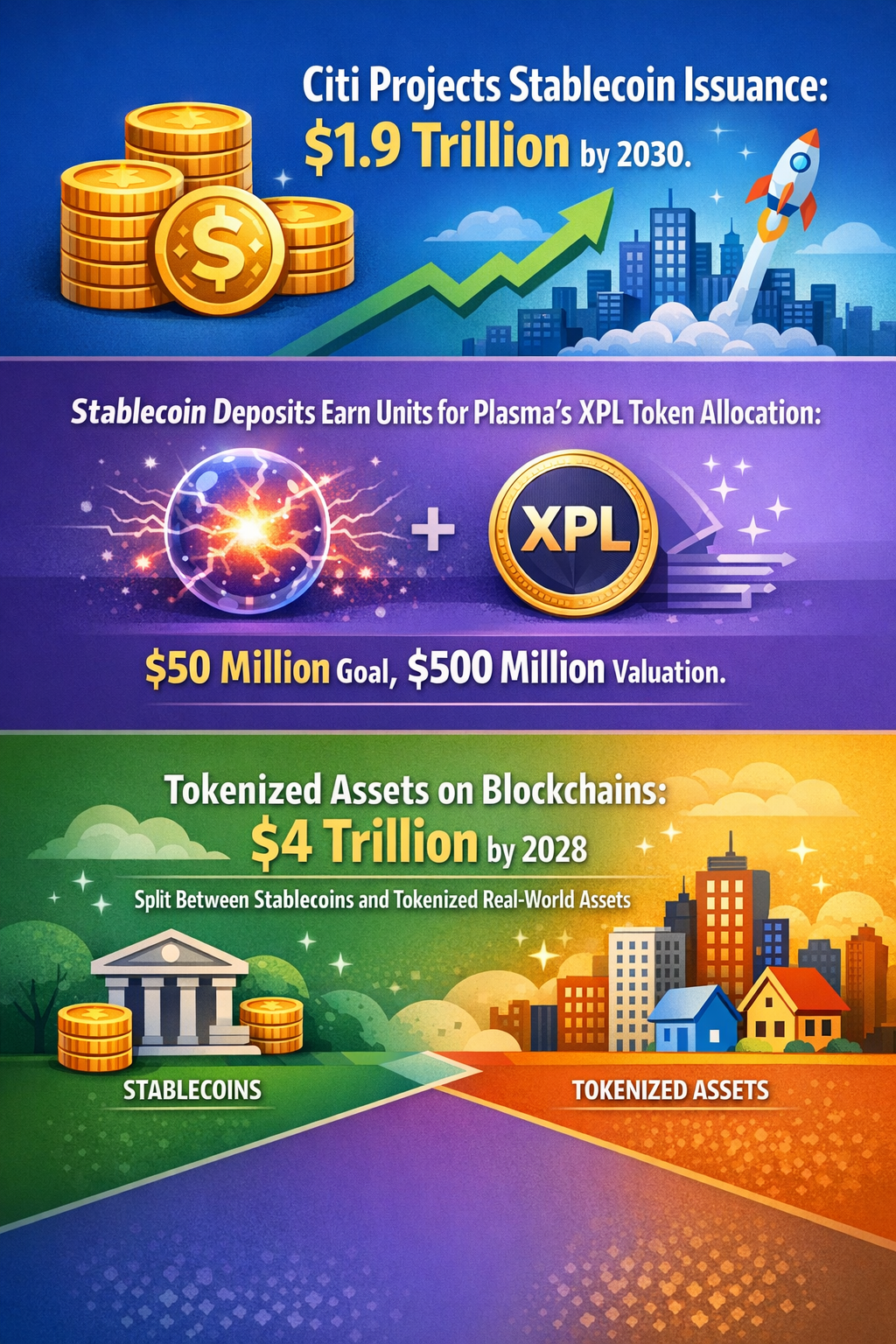
Recent institutional forecasts anticipate explosive tokenisation growth: Citi projects stablecoin issuance hitting $1.9 trillion by 2030 (Investing.com 11/05/2023), while Standard Chartered estimates $4 trillion in tokenised assets including bonds and funds by 2028 (CoinDesk 18/05/2026). Concurrently, policy circles assume that regulated private stablecoins (e.g., USDC, USDT under US Asset Tokenization frameworks) will accommodate most digital dollar use cases in the medium term (ECO.com 01/04/2026).
Crucially, these forecasts and assumptions illustrate a coalescing expectation rather than fragmentation: America’s Federal Reserve digital currency initiatives pose competitive yet complementary dynamics to private stablecoins (CryptoBriefing 05/03/2026). Regulators increasingly treat private stablecoin and CBDC efforts as interdependent layers within broader digital currency architectures rather than zero-sum options. This signals a departure from prior binary debates and suggests policy frameworks will evolve to enable interoperability, layered regulation, and asset-native compliance protocols.
Moreover, tokenised real-world assets are becoming an essential complement to stablecoins, embedding decentralised finance (DeFi) protocols with robust collateral and liquidity—potentially altering industrial structures by formally integrating capital markets and digital asset infrastructures into a hybrid ecosystem (CoinDesk 18/05/2026; Investing.com 11/05/2023).
The genuinely novel and under-recognised structural theme is the emergent regulatory convergence around tokenised fiat-denominated assets, digital dollar representations, and central bank involvement with privately operated distributed ledger technology (DLT) networks. Unlike the hype surrounding DeFi’s permissionless disruption or CBDC rollouts viewed in isolation, this hybrid regulatory architecture promises systemic changes in capital allocation frameworks and liability regimes.
Disruption Pathway
This emergent regulatory convergence may be accelerated by rising geopolitical pressures to establish digital dollar leadership, the rising complexity of asset tokenisation, and heightened concerns over systemic financial stability in hybrid models. As stablecoins scale towards multi-trillion-dollar market capitalisations, legitimisation via regulatory alignment with central bank frameworks could become a prerequisite for institutional participation, creating upward pressure for direct public-private collaboration.
Stress points will arise from jurisdictional arbitrage risks, legal uncertainty around asset-holder rights, and operational complexities of integrating CBDC rails with private stablecoin ecosystems. Financial market infrastructures will face demands to adapt custodial arrangements, settlement finality definitions, and cross-network atomicity protocols. These pressures could incentivise the emergence of layered governance bodies or consortia that coordinate standards and risk-sharing mechanisms across public and private digital currency infrastructures.
Structural adaptations may include the institutionalisation of token governance frameworks that blend centralised regulatory oversight with decentralised on-chain governance components, enabling more agile yet compliant capital flow management. Feedback loops may emerge as improved on-chain transparency drives regulatory confidence, which in turn fuels broader adoption and further technical integration.
Under these conditions, dominant industry structures could shift away from siloed banking, exchange, and custodial entities towards hybrid consortia or “regtech-embedded” DeFi platforms supervised under co-regulatory models involving central banks, securities commissions, and financial stability boards. The regulatory framework itself may evolve from prescriptive to adaptive, leveraging real-time DLT auditability, thus altering traditional timelines and processes for compliance and enforcement.
Why This Matters
For senior decision-makers, this evolving convergence carries direct implications for capital deployment strategies, regulatory compliance risk, and industrial positioning across the finance sector. Capital allocation could increasingly favour ecosystem players who can navigate and leverage compliant token interoperability rather than isolated blockchain operators or CBDC pilots.
Regulators may face new governance challenges involving multi-jurisdictional coordination, cross-sectoral oversight, and balancing innovation with systemic risk containment. Government agencies may need to rethink liability frameworks and enforcement models to encompass novel digital intermediaries and decentralized actors.
Strategically, incumbent financial institutions and fintech innovators must consider whether to invest in emerging interoperable standards or risk obsolescence. Supply chain effects may surface as Oracle providers, custodians, and identity verification services become critical nodes in hybrid compliance architectures.
Implications
This convergence could plausibly recalibrate how monetary policy is transmitted as tokenised assets and private digital dollars gain systemic influence, complementing or partially substituting traditional bank deposits and payment systems. It may therefore shift the control of liquidity, credit access, and financial market intermediation towards digitally native, programmable infrastructures.
The structural change from siloed models to hybrid frameworks integrating regulated stablecoins, CBDCs, and tokenised real assets may strengthen resilience yet challenge existing prudential regulations built around conventional banking and securities paradigms. This development should not be confused with fleeting hype around DeFi yield products or retail-driven crypto speculation—it is fundamentally a governance and architectural pivot in the digital finance ecosystem.
Competing interpretations might undervalue this convergence, focusing instead on zero-sum contests between CBDCs and private stablecoins or overemphasise the pace of technological adoption while neglecting regulatory dynamics. The nuanced blending of these spheres is currently underemphasised but may in fact reconfigure the future landscape of capital markets and digital currency regulation.
Early Indicators to Monitor
- Draft regulatory frameworks explicitly addressing interoperability between CBDCs and private stablecoins.
- Cross-border regulatory coordination initiatives on digital asset governance and standards alignment.
- Launch and scaling of hybrid public-private digital currency pilot projects involving both central banks and regulated stablecoins.
- Venture funding and strategic partnerships targeting regtech layers designed for compliance automation across tokenised asset classes.
- Standards formation within international bodies (e.g., BIS, IOSCO) regarding tokenised asset custody, settlement, and transparency protocols.
Disconfirming Signals
- Fragmentation in national digital currency policy frameworks, resulting in incompatible CBDC and stablecoin models.
- Regulatory crackdowns forbidding interaction or interoperability between public and private digital currencies.
- Failure of major tokenised asset infrastructure projects due to legal or technological barriers.
- Persistent market preference for traditional banking instruments over all digital tokens despite regulatory incentives.
Strategic Questions
- How might investment portfolios shift if tokenised assets governed by interoperable digital currencies become a core institutional liquidity layer?
- What frameworks could regulators develop to balance innovation in tokenised finance with systemic risk and consumer protection?
Keywords
Regulatory Convergence; Tokenised Assets; Stablecoins; CBDC; Decentralised Finance; Digital Currency Interoperability; Financial Regulation
Bibliography
- Asset Tokenization Is Wall Street’s Next $5.5 Trillion Shift. Investing.com. Published 11/05/2023.
- What is a CBDC? 2026 Update. ECO.com. Published 01/04/2026.
- Tokenization Push Could Pull Trillions of Dollars Into DeFi, StanChart Says. CoinDesk. Published 18/05/2026.
- Senate Blocks FISA Extension, Slowing Crypto CBDC Prospects. CryptoBriefing. Published 05/03/2026.
- Stablecoins and Digital dollar Regulations Report. ECO.com. Published 01/04/2026.