
Quantum-Hardened IoT Architectures: The Understated Inflection in Connectivity's Post-Quantum Era
Emerging quantum-resistant hardware integrated into IoT devices signals a nascent structural shift in connectivity, with broad implications for security, industrial standardization, and capital deployment over the next two decades. This subtle evolution could redefine regulatory frameworks and reshape the industrial landscape far beyond typical network upgrades.
Connectivity is currently dominated by rapid 5G adoption and the anticipated rise of 6G to meet soaring spectrum and data demands, as well as satellite IoT expansions. However, embedded within these transitions is a relatively underexplored technological inflection: the adoption of RISC-V microcontrollers explicitly optimized for post-quantum cryptographic primitives, as exemplified by emerging solutions like the QS7001 chip, poised for regulated procurement in critical sectors. This foundational hardware innovation may catalyze a paradigm shift, establishing new security baselines and industrial dependencies that will influence capital allocation, regulatory design, and strategic positioning across telecommunications, aerospace, energy, and defense sectors throughout the coming decades.
Signal Identification
This development qualifies as an emerging inflection indicator rather than a mere weak signal or speculative wildcard. Unlike incremental improvements in network speed or coverage typically associated with 5G or 6G rollouts, integrating post-quantum cryptography directly into IoT microcontrollers represents a foundational shift in hardware-level trust architecture. It will plausibly take 10–20 years to fully scale across global industrial ecosystems, given certification cycles and supply chain inertia. The plausibility band is medium to high, with regulatory mandates in the US and European Union accelerating adoption for critical infrastructure and aerospace electronics.
Sectors exposed include telecommunications, aerospace, energy (specifically smart grids), IoT device manufacturing, and national security-related connectivity systems.
What Is Changing
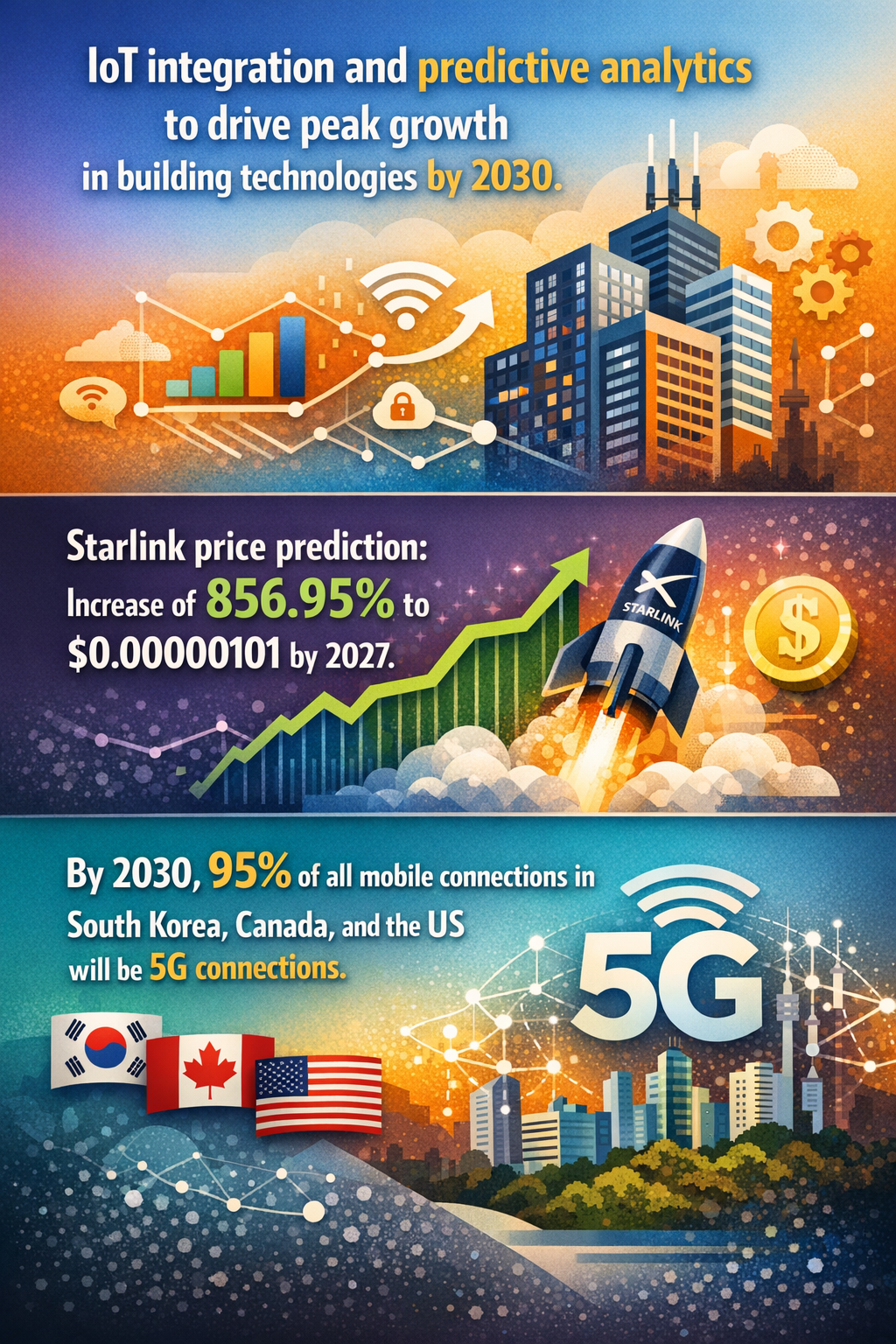
The connectivity landscape is advancing rapidly toward ubiquitous 5G coverage, projected to constitute 95% of mobile connections in advanced markets like South Korea, Canada, and the United States by 2030 (IMARC Group 15/03/2026). Concurrently, satellite IoT technologies are extending coverage and enterprise use cases beyond terrestrial network confines, amplifying maritime and remote industrial connectivity (NewMarketPitch 11/06/2026).
Overlaying this ubiquitous connectivity expansion is the imperative to secure a staggering projected 50 billion connected IoT devices globally by 2030 (Persistence Market Research 18/01/2026). As conventional cryptographic protections face obsolescence due to anticipated quantum computing advancements, early commercial microcontrollers embedding post-quantum security measures like the QS7001, which leverage open architecture instruction sets such as RISC-V, are converging multiple priorities: regulatory compliance for "trusted procurement," assured resilience of critical infrastructure, and compatibility with emerging 6G-enabled networks that demand drastically larger spectrum use and enhanced security (Quantum Computing Report 29/04/2026; The Register 03/06/2026).
What is under-recognized is the magnitude of infrastructural debt being accrued by current legacy connectivity stacks that are not quantum-hard, creating latent systemic vulnerabilities. The integration of post-quantum primitives at the chip level enables a bottom-up re-architecture of industrial ecosystems—particularly IoT in energy smart grids, aerospace electronics, and regulatory-controlled supply chains—beyond the usual focus on spectral efficiency or data throughput.
Disruption Pathway
The initial disruptive dynamics will be driven by regulatory environments tightening cybersecurity mandates, specifically for critical infrastructure and aerospace sectors, where procurement increasingly prioritizes quantum-safe systems. These regulations could rapidly accelerate demand for post-quantum-equipped processors such as the QS7001 (Quantum Computing Report 29/04/2026).
Simultaneously, network operators preparing for 6G deployment face spectrum tripling challenges, making system security inseparable from spectrum management and integrity. This convergence places additional pressure on integrated hardware security solutions that can protect not only data but also signaling and control layers vulnerable to quantum-enabled adversaries (The Register 03/06/2026).
As trust anchors shift from software or network perimeter defenses to embedded hardware roots of trust, value chains may fragment, with non-certified suppliers excluded from regulated procurement, leading to concentration among chip producers able to deliver certified post-quantum capabilities. This adaptation could reshape industrial structures, particularly in IoT device manufacturing and aerospace electronics.
Feedback loops appear where early movers secure this critical certification and gain preferential access to government and enterprise contracts, reinforcing capital flows into quantum-safe R&D and manufacturing capabilities. These flows may also accelerate investments in next-gen satellite IoT networks, such as those spearheaded by high-valuation players like SpaceX Starlink integrating AI and connectivity expansions (SFA Research 12/06/2026).
Dominant connectivity models predicated on legacy cryptographic assumptions risk obsolescence, pressuring standards bodies to revise certification frameworks globally. A shift toward regulatory designs emphasizing quantum resilience will likely follow, potentially upending existing competitive dynamics and supply chain dependencies across transatlantic industrial hubs.
Why This Matters
Capital allocators must recognize this reorientation as more than a marginal hardware upgrade; it is a protracted paradigm shift that might rewrite procurement criteria within regulated industries, heightening demand for quantum-secure components. Traditional semiconductor investments oriented solely toward speed and miniaturization may face obsolescence without corresponding quantum resilience.
Regulators will need to adapt frameworks governing secure procurement, especially for smart grids, aerospace systems, and IoT deployments tied to national infrastructure, to embed post-quantum certifications. Competitive positioning will increasingly favor entities investing early in quantum-hardened hardware stacks, with supply chains realigning to prioritize trusted foundries and interoperability standards specific to next-generation cryptographic resilience.
This shift also recalibrates risk governance—organizations continuing to deploy legacy cryptographic chips in IoT systems may face elevated liability exposure due to vulnerable attack surfaces in a post-quantum threat environment. Consequently, the transition pathways to quantum-safe IoT architectures may become focal points of governance and compliance scrutiny.
Implications
This development could plausibly scale into a profound structural change, setting new global norms for IoT security anchored in hardware-level post-quantum cryptography. It might catalyze a bifurcation of suppliers between quantum-hardened ecosystem participants and legacy-oriented incumbents, with cascading effects on investment, innovation cycles, and international regulatory alignment.
It is unlikely to be a transient trend limited to niche sectors; rather, its integration into 6G network standards and smart grid deployments indicates broad systemic relevance. However, competing interpretations exist: some may argue that quantum computing timelines are exaggerated, delaying widespread urgency for quantum-resistant hardware, which would constrain near-term capital shifts.
Moreover, alternative cryptographic innovations at the software layer could slow hardware-level quantum resistance adoption, preserving legacy architectures longer than anticipated.
Early Indicators to Monitor
- Surge in procurement contracts explicitly requiring quantum-safe microcontrollers for regulated IoT applications
- Standards bodies’ publication of quantum-resistant IoT certification frameworks and interoperability protocols
- Venture capital and corporate investment clustering in post-quantum RISC-V chip designers and trusted foundries
- Inclusion of quantum-resilience requirements in 6G network infrastructure specifications
- Government policies updating cybersecurity procurement mandates for critical infrastructure to include post-quantum primitives
Disconfirming Signals
- Delays or revocation of post-quantum cryptography standards in industrial or regulatory institutions
- Disrupted supply chains limiting scalable production of quantum-hardened processors
- Significant breakthroughs in alternative, non-hardware based cryptographic methods that reduce immediate need for post-quantum chips
- Widespread evidence that quantum computing timelines are extended beyond 20 years, deflating urgency
- Regulatory rollback of stringent procurement requirements due to cost or complexity concerns
Strategic Questions
- How should capital allocation strategies pivot to capture the emerging market for post-quantum secured IoT hardware, especially in regulated sectors?
- What regulatory frameworks and certification standards must be reshaped to institutionalize quantum resilience across critical connectivity infrastructures?
Keywords
Post-Quantum Cryptography; IoT; RISC-V; 6G; Quantum Resilience; Smart Grid; Regulatory Framework; Connectivity
Bibliography
- The QS7001, designed with a RISC-V microcontroller optimized for post-quantum primitives, will serve regulated procurement channels in the US and EU for applications like IoT, smart grids, and aerospace electronics. Quantum Computing Report. Published 29/04/2026.
- By 2030, 5G connections are expected to make up 95% of all mobile connections in South Korea, Canada, and the United States. IMARC Group. Published 15/03/2026.
- 6G networks will need up to three times the spectrum currently allocated for 5G, and was measuring up various mid-band frequencies. The Register. Published 03/06/2026.
- The number of connected IoT devices is projected to surpass 50 billion globally by 2030. Persistence Market Research. Published 18/01/2026.
- Quilty Space's 2026 Starlink financial outlook highlighted maritime revenue growth and enterprise expansion as meaningful contributors, with maritime revenue projected near $1.94 billion in 2026. NewMarketPitch. Published 11/06/2026.
- SpaceX - with its $2 trillion valuation, Starlink subscription engine, and xAI artificial intelligence business - will generate demand that dwarfs anything Medline produced. SFA Research. Published 12/06/2026.