
Terahertz-Enabled Maritime Connectivity: An Under-Recognized Inflection in Global Connectivity Infrastructure
Emerging terahertz communication technologies integrated with agentic AI and maritime connectivity represent a weak signal poised to redefine global digital infrastructure and industrial logistics over the next two decades.
While conventional discourse centers largely on terrestrial 5G and upcoming 6G wireless networks, a subtle but profound transformation is incubating through the marriage of edge AI, terahertz frequencies, and ubiquitous connectivity in maritime domains. This development could recalibrate capital flows, regulatory frameworks, industrial structures, and strategic positioning across telecom, logistics, and national security sectors from 2030 onwards. Its systemic implications remain largely underappreciated outside specialized research.
Signal Identification
This signal qualifies as an emerging inflection indicator, given early-stage but accelerating investments and technological demonstrations into terahertz frequency communications combined with AI-driven agentic systems applied extensively beyond traditional terrestrial networks. It stands apart from the mainstream 5G/6G evolution conversations by focusing on non-terrestrial, high-frequency maritime applications that deliver transformative visibility, autonomy, and capacity.
The plausible horizon is 10–20 years, with a medium-to-high plausibility band given direct public and private sector technology backing in Asia-Pacific 5G expansions, maritime IoT initiatives, and SpaceX satellite capacity growth.
Sectors notably exposed include telecommunications, maritime and global logistics, AI ecosystems, regulatory bodies for spectrum management, and critical infrastructure governance.
What Is Changing
The trajectory toward a globally interconnected, agentic maritime environment supported by terahertz communications introduces a paradigm shift. Ericsson’s recent efforts to deploy secure, carrier-grade 4G/5G connectivity onboard container vessels that enable “agentic AI-ready data” exemplify the fusion of advanced connectivity with autonomous, decision-capable systems in mobility and logistics (PR Newswire 02/06/2023).
Simultaneously, exploratory 6G research pushes terahertz communication and reconfigurable intelligent surfaces, promising unprecedented data speeds and expansive coverage beyond the limitations of lower frequency bands (PMC NCBI 18/04/2023). China’s accelerated timetable for 6G technical standards (targeting 2027 completion) underlines state-level prioritization of these technologies (Yahoo Finance 05/02/2024).
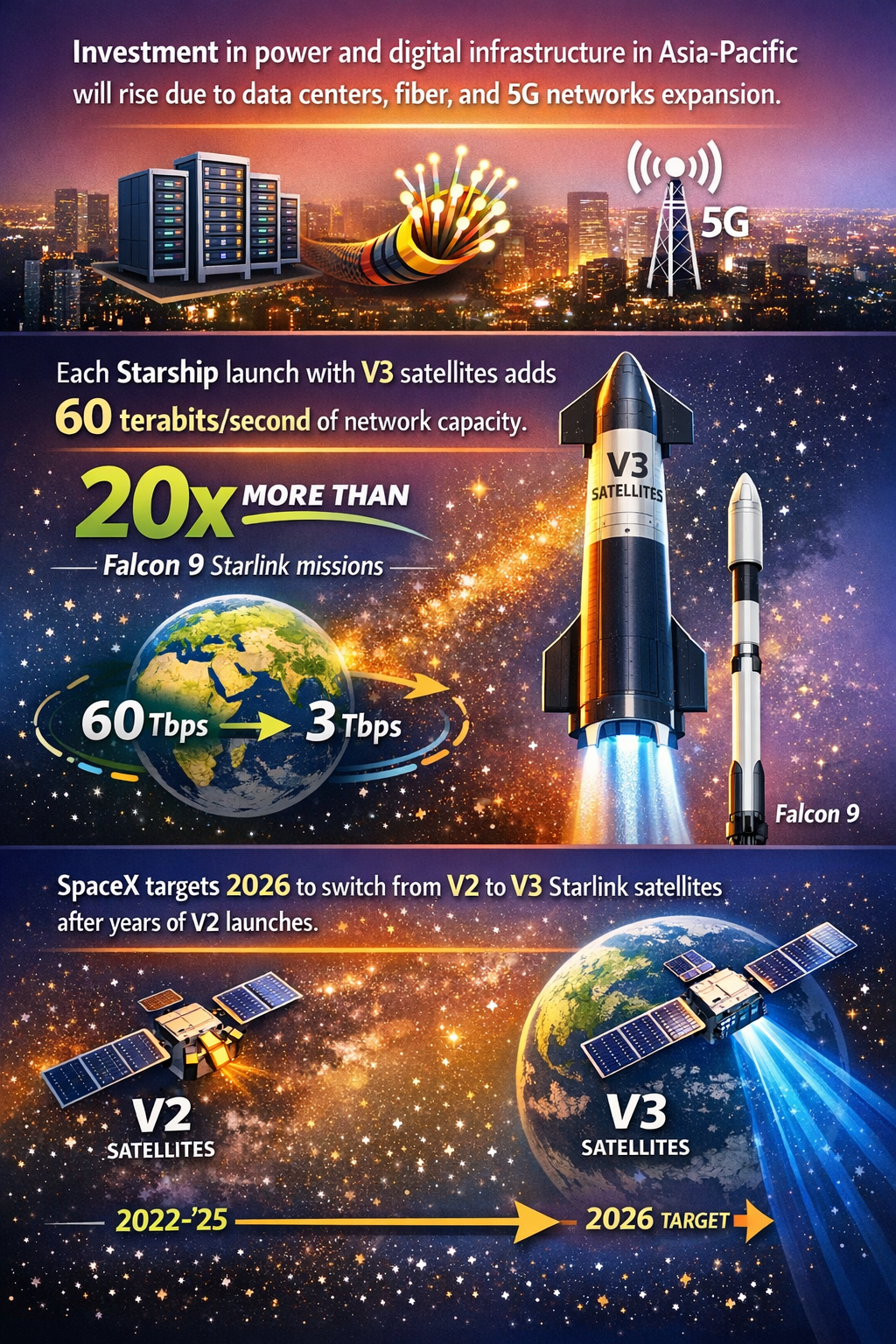
Meanwhile, SpaceX’s Starlink constellation, leveraging Starship launches and FCC regulatory shifts to multiply satellite capacity seven-fold by 2026, amplifies space-based broadband that can supplement and synergize with maritime terahertz connectivity, collectively enabling continuous global connectivity for vessels anywhere on the oceans (Benzinga 26/05/2024; Space Explored 08/05/2026).
Collectively, these developments mark a shift from isolated, terrestrial cellular paradigms to an integrated, multi-domain connectivity framework where sea-going vessels dynamically participate as autonomous agents in expansive global supply chains. The alignment of AI, IoT growth (with a projected 40 billion connected devices by 2030), and innovative frequency use underlines a systemic inflection well beyond incremental technology upgrades (Persistence Market Research 12/04/2024; Market Data Forecast 22/03/2024).
Disruption Pathway
Terahertz maritime connectivity with agentic AI could accelerate as a critical infrastructure cornerstone through several mechanisms. First, rising demand for ultra-reliable, low-latency communication in global supply chains incentivizes heavy investment and public-private partnerships in next-generation maritime networks to achieve unprecedented cargo visibility and automated decision-making at scale.
This acceleration exerts pressure on legacy satellite and undersea cable infrastructures, revealing gaps in latency, coverage, and data security. Governments then face intensifying trade-offs in regulatory frameworks balancing spectrum allocation, international coordination, and critical infrastructure cybersecurity. These pressures may induce regulators to adopt more agile, multi-jurisdictional governance mechanisms reflecting the cross-domain nature of terahertz-enhanced connectivity.
As the agentic AI dimension matures, autonomous vessel operations and real-time global logistics become the norm, triggering shifts in industrial structure. Traditional shipping firms may vertically integrate or partner with telcos and AI firms, while new entrants leveraging these capabilities disrupt conventional market leaders.
Feedback loops could emerge as widespread machine-to-machine systems accelerate data volumes and spectrum use, further motivating innovation in dynamic spectrum management and edge AI processing. Unintended consequences could include new vulnerability vectors in cyber-physical systems and geopolitical tensions over spectrum and satellite use rights, prompting structural adaptations in international regulatory forums.
Under these evolving dynamics, current dominant models rooted in terrestrial telecom monopolies and siloed logistics providers may give way to multi-stakeholder coalitions centering around AI-enabled maritime and space infrastructure ecosystems.
Why This Matters
Decision-makers in capital allocation, industrial strategy, telecommunications regulation, and national security must recognize that this signal could markedly redirect investment flows toward integrated space-terrestrial-maritime networks.
Capital markets may need to adjust risk models and valuations, anticipating value shifts from terrestrial-only players to multispectral system integrators. Regulators face pressure to modernize spectrum management across terrestrial, maritime, and orbital domains, requiring cross-border cooperation and new frameworks for agentic AI accountability.
Supply chains may significantly benefit from real-time AI-enabled visibility, but also confront increased complexity and new liability risks tied to autonomous operations and cyber-physical system interdependencies.
Countries and firms unable or unwilling to engage with these emerging infrastructures may see their strategic competitiveness erode in the global digital economy.
Implications
This development might catalyze a fundamental restructuring of global telecommunications from predominantly land-based 4G/5G/6G systems toward integrated multi-domain networks coupling maritime terahertz links, satellite constellations, and AI-enabled control systems.
It could reshape competitive landscapes, privileging actors capable of managing multi-spectral infrastructure and AI governance, and might catalyze novel regulatory architectures blending spectrum policy, autonomous systems oversight, and critical infrastructure protection.
However, it is not a near-term replacement for 5G dominance or a simple satellite internet upgrade; rather it is a longer-horizon transformation quietly incubating within existing technological overlaps and sectoral intersections.
Alternative interpretations might construe the signal as incremental enhancement in maritime IoT or satellite broadband rather than a systemic inflection, but evidence suggests the combination of terahertz frequencies, agentic AI, and maritime connectivity portend deeper industry and regulatory evolution.
Early Indicators to Monitor
- Patents and technical standards filings on terahertz communication and reconfigurable intelligent surfaces.
- Public-private partnerships and government budgets specifically targeting agentic AI maritime connectivity in Asia-Pacific and maritime hubs.
- Satellite constellations’ capacity upgrades and corresponding FCC or international regulatory approvals.
- Venture capital clustering around multi-domain AI connectivity systems integrating maritime, space, and terrestrial networks.
- Regulatory drafts evidencing cross-jurisdictional spectrum management reforms.
Disconfirming Signals
- Prolonged technical failure or slow maturation of terahertz hardware and atmospheric transmission reliability.
- Geopolitical fragmentation halting international cooperation on maritime spectrum and satellite use.
- Regulatory retrenchment reverting to siloed terrestrial spectrum policies.
- Insufficient economic incentives diminishing private sector investment in maritime AI networks.
- Major cybersecurity incidents or liability crises resulting in public backlash against autonomous maritime systems.
Strategic Questions
- How should capital deployment strategies adapt to prioritize multi-domain connectivity infrastructure that includes maritime terahertz and space-based systems?
- What new regulatory coordination mechanisms are required to govern AI-enabled autonomous maritime networks alongside terrestrial and orbital communication regimes?
Keywords
Terahertz Communication; Maritime Connectivity; Agentic AI; 5G 6G; SpaceX Starlink; Spectrum Regulation; Autonomous Vessels; Logistics Digitalization
Bibliography
- The 2026-2030 five-year plan emphasises support for industrial and technological development, particularly artificial intelligence, 6G technology, robotics, quantum computing and industries supporting the green transition. / China. BOFIT. Published 18/01/2024.
- Secure, carrier-grade 4G/5G connectivity on-board container vessels, delivering agentic AI-ready data, will improve cargo visibility and increase operational efficiency across the maritime industry, regardless of location on the world's oceans. PR Newswire. Published 02/06/2023.
- China is accelerating the R&D and formulation of 6G technical standards, with the technical research phase expected to be completed in 2027. Yahoo Finance. Published 05/02/2024.
- 6G research is exploring technologies such as terahertz communication, reconfigurable intelligent surfaces and cell-free massive MIMO, which could provide even higher data speeds and wider coverage. PMC NCBI. Published 18/04/2023.
- SpaceX's Starlink could see capacity rise as much as seven-fold under new Federal Communications Commission rules approved this week, a regulatory shift aimed at improving satellite internet speed, reliability and costs. Benzinga. Published 26/05/2024.
- SpaceX has been launching its v2 Starlink satellites for years but hopes to switch to v3 satellites in 2026. Space Explored. Published 08/05/2026.
- There were 18.8 billion connected IoT devices by the end of 2024, with projections indicating growth to 40 billion devices by 2030. Persistence Market Research. Published 12/04/2024.