
The Emerging Disruption of Drone Warfare and Autonomous Systems in Global Security
Drone warfare and autonomous weapon systems (AWS) have evolved beyond niche applications and may soon reshape global conflict dynamics, security protocols, and international regulations. A weak but accelerating signal is the integration of hyper-modern drone tactics, increasing use of lethal autonomous capabilities, and cyber warfare interplay, particularly noticeable in hotspots such as Eastern Europe and regional conflicts in Africa. This multidimensional convergence could disrupt defense industries, global supply chains, and geopolitical stability over the next two decades.
What's Changing?
The landscape of drone warfare is undergoing rapid transformation, driven by advancements in drone technology, artificial intelligence (AI), and strategic state partnerships. The conflict in Ukraine exemplifies a critical supply dependency on Chinese-origin components, without which neither Russia nor Ukraine could sustain their current intensity of drone operations (The Diplomat). This reliance reveals a latent vulnerability in global military supply chains, creating potential chokepoints or leverage in geopolitical tensions.
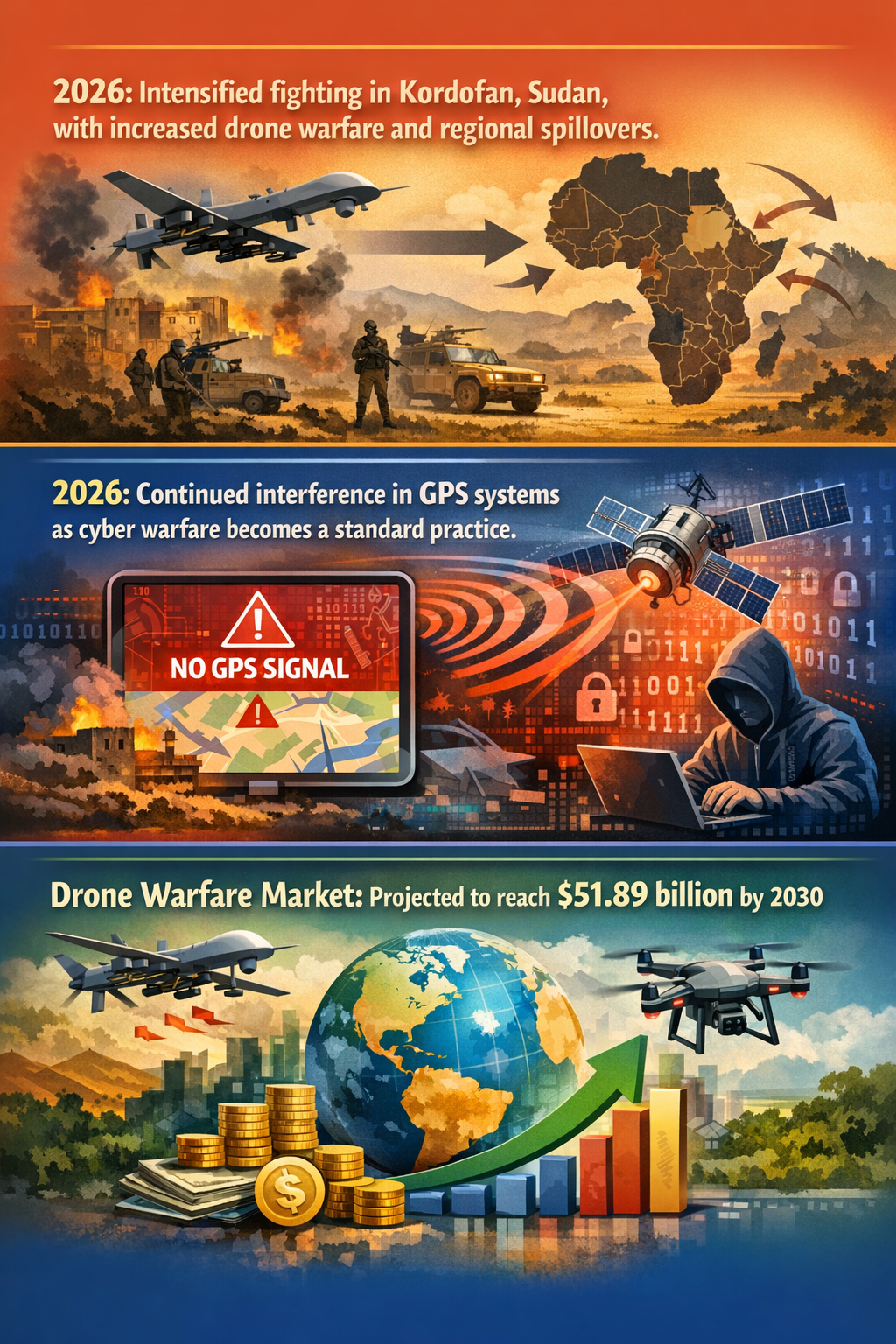
Additionally, incidents of drone warfare have intensified across diverse regions, including the Black Sea, the Caribbean Sea, the Gulf of Guinea, and Africa’s Kordofan area, where drone strikes contribute significantly to conflict escalation (Palaemon Maritime; Assodesire). This signals a broader adoption of unmanned systems in asymmetric conflict zones beyond traditional state-on-state warfare.
Concurrently, the development and deployment of Lethal Autonomous Weapon Systems (LAWS) are becoming a focal point within international policy forums, including United Nations discussions under the Convention on Certain Conventional Weapons. While current treaty negotiations lack direct enforcement mechanisms, they serve as indicators of emerging policy trajectories that might shape future defense procurement and program requirements (Gradient Federal).
The integration of AI into military decision-making further accelerates this trend. The recent conflict involving Israel and Hamas demonstrates that AI-driven systems now influence tactical operations and command structures, potentially increasing the speed and precision of responses in complex combat scenarios (CCW Oxford).
Cyber warfare emerges as a symbiotic threat alongside drone warfare. GPS interference attacks, identity-based cyber intrusions, and ransomware campaigns are increasingly incorporated into military and geopolitical strategies, broadening the attack surfaces involved in conflict and complicating defense measures (Euronews; Firstpost).
The capture of intact armed unmanned surface vessels (USVs) could become a critical intelligence goal, allowing non-state actors or rival states to reverse-engineer command and control architectures, potentially destabilizing existing autonomous systems and increasing cybersecurity concerns (Drone Warfare).
Why is this Important?
These developments collectively indicate a pivotal shift in how warfare and security could unfold over the next 5 to 20 years. Drone warfare is no longer an adjunct to traditional forces but is becoming a central domain for military contestation. This evolution may:
- Alter global power balances by lowering the threshold for military engagement, enabling smaller actors to exert outsized influence.
- Create vulnerabilities in defense supply chains, especially where critical components depend on geopolitically sensitive sources like Chinese manufacturing.
- Pressure international governance systems to address the ethical, legal, and operational challenges presented by autonomous weapons.
- Integrate cyber and physical domains of warfare, making defense more complex and requiring higher investments in cybersecurity resiliency.
- Encourage new forms of intelligence gathering, including potential exploitation of captured autonomous systems, which could spur arms races in AI-enabled military technologies.
From an industry perspective, defense contractors may face rapidly shifting program requirements and regulatory landscapes, particularly if UN conventions result in more binding measures or if states independently impose export controls. The convergence of drone warfare and cyber operations suggests a future in which multi-domain security capabilities are critical for both national defense and commercial enterprises involved in infrastructure, logistics, and technology exports.
Implications
The confluence of drone warfare, AI-driven command systems, and cyber attacks creates a complex milieu demanding strategic foresight from governments, militaries, and businesses. Potential implications include:
- Supply Chain Resilience: Nations and private sector actors may need contingency plans to reduce dependency on vulnerable foreign components, especially from geopolitical rivals. Diversification and indigenous innovation in drone and AI components could become strategic imperatives.
- Policy Evolution: International diplomatic efforts, while currently limited in enforcement, might accelerate toward treaties restricting or regulating autonomous weapons to prevent destabilizing arms races.
- Cybersecurity Investments: Protecting command-and-control structures of autonomous systems and countering GPS jamming or spoofing could require enhanced defensive architectures and real-time anomaly detection systems.
- Intelligence Priorities: Capturing and analyzing adversary unmanned systems may intensify, driving demand for advanced electronic warfare capabilities and reverse-engineering expertise.
- Operational Doctrine Changes: Military and security organizations might integrate AI and autonomous systems into broader joint operations, requiring new skill sets, operational doctrines, and ethical frameworks.
- New Conflict Dynamics: The expanding role of commercial supply chains in military conflicts underscores the blurred boundaries between civilian and military domains, challenging traditional notions of warfare and raising risks of spillover effects.
Industries supporting drone manufacturing, systems integration, AI development, and cybersecurity stand at a strategic inflection point. They may be called upon to innovate rapidly while navigating evolving legal and ethical expectations.
Questions
- How might defense organizations restructure supply chains and procurement to mitigate risks from geopolitical dependencies on key drone and AI components?
- What frameworks could governments and international bodies develop to ensure credible and enforceable regulation of lethal autonomous weapons?
- How will cybersecurity strategies evolve to protect integrated drone and autonomous systems from increasingly sophisticated adversarial attacks?
- What role could commercial enterprises play in developing resilient and traceable supply chains that support both civilian and military needs?
- How might emerging technology disruptors capture and exploit adversarial autonomous systems without triggering escalatory consequences?
- In what ways will operational doctrines adapt to the interplay of AI-driven decisions and human oversight in battlefield environments?
Keywords
drone warfare; autonomous weapons; AI in military; cyber warfare; supply chain vulnerabilities; international arms control
Bibliography
- Palaemon Maritime. (2026, January 26). Threat levels remain high across the Black Sea and Europe and are increasing across other regions. https://www.palaemonmaritime.com/post/maritime-security-report-19-26-january-2026
- The Diplomat. (2026, January). China’s drone war in Ukraine. https://thediplomat.com/2026/01/chinas-drone-war-in-ukraine/
- Gradient Federal. (2026, January 18). Mastering federal AI procurement: A strategic guide for government contractors. https://gradientfederal.com/index.php/2026/01/18/mastering-federal-ai-procurement-a-strategic-guide-for-government-contractors/
- CCW Oxford. (2026, January 16). Hyper-modern drone warfare and AI in military decision-making. https://www.ccw.ox.ac.uk/news/2026/1/16/call-for-papers
- Euronews. (2026, January 12). From AI breaches to rising geopolitical threats: What to expect from cybersecurity in 2026. https://www.euronews.com/next/2026/01/12/from-ai-breaches-to-rising-geopolitical-threats-heres-what-to-expect-from-cybersecurity-in
- Drone Warfare. (2026, January 19). Capturing intact armed USVs and intelligence implications. https://drone-warfare.com/2026/01/19/unmanned-systems-warfare-analysis-jan-12-18-2026/