
The Emerging Disruption of Satellite IoT as a Global Operational Nervous System
Satellite-based Internet of Things (IoT) is subtly transforming from a niche technology to a foundational layer of global connectivity, operational intelligence, and critical infrastructure. Developments in satellite IoT integration with artificial intelligence (AI), network upgrades, and regulatory changes reveal a weak signal of growing industrial and societal disruption by 2026 and beyond. As satellite constellations multiply and lower their orbits, their IoT capabilities may evolve into a real-time operational nervous system for industries, governments, and critical services worldwide.
What’s Changing?
The satellite IoT industry is poised for major transformation driven by several converging trends. By 2026, satellite IoT could experience significant scalability and integration improvements that expand its role far beyond traditional consumer broadband or tracking applications.
First, satellite internet is evolving towards a layered global infrastructure composed of diverse technologies and market models, which may define competitive advantages in the future (Lexology). This layered approach balances low-Earth orbit (LEO) constellations, geostationary satellites, and emerging high-altitude platforms to deliver more resilient, global coverage.
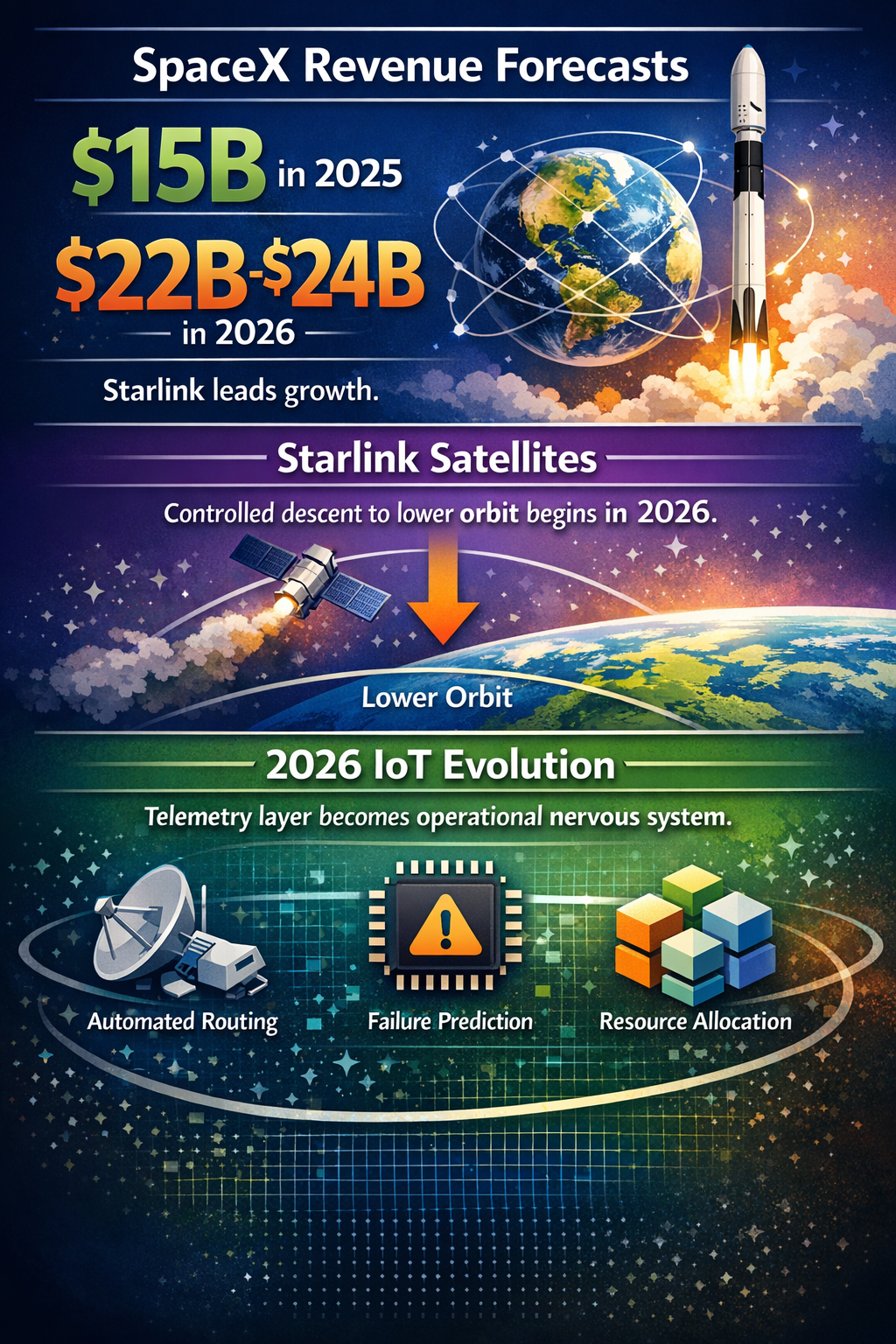
Second, companies like SpaceX are adjusting satellite orbits to mitigate space debris risks by lowering Starlink satellites from approximately 550 kilometers to 480 kilometers altitude in 2026. This orbit management is critical for sustainable growth and operational safety of satellite IoT networks (Techno-Science), (Yahoo News).
Third, satellite IoT devices will increasingly incorporate AI-powered analytics and security-by-design principles to automate incident detection, prediction, lifecycle management, and resource allocation without human intervention (Digital IT News), (SkyQuest).
Fourth, the integration of edge AI and upgraded terrestrial network infrastructure such as 5G and fiber optics will complement satellite IoT services, enabling a handoff between ground and space networks. Telecom firms expect revenue growth from these upgrades into 2026 (ING Think).
Finally, the business valuation outlook signals market confidence in this trend. SpaceX’s Starlink is projected to grow revenue from $15 billion in 2025 to $22-24 billion in 2026, primarily through satellite broadband and IoT services (AINvest), hinting at rapid growth and expanding use cases.
Why is this Important?
The maturation of satellite IoT as an intelligent, autonomous global nervous system holds profound implications across industries and governments:
- Expanded remote connectivity: Satellite IoT could enable persistent, low-latency data flows from assets in remote or harsh environments—farms, pipelines, shipping lanes, emergency zones—where terrestrial connectivity is unavailable or unreliable.
- Real-time operational intelligence: AI-driven satellite IoT networks may autonomously detect failures, reroute resources, and optimize logistics in sectors like energy, agriculture, defense, and transportation. This could significantly reduce downtime, improve safety, and enhance decision quality.
- Industrial automation at scale: Satellite IoT’s progression combined with edge computing could usher in new models for vast asset monitoring and control, turning previously static infrastructure into dynamic, intelligent systems with reduced need for human oversight.
- Security and resilience: Incorporating security-by-design in satellite IoT architectures reduces vulnerabilities, but also heightens the stakes. The global dependency on these networks might make them targets for cyberattacks, requiring proactive governance frameworks and robust international cooperation.
- Environmental and orbital sustainability: The lowering of satellite orbits to manage space debris signals growing recognition of the environmental impact of satellite constellations. This trend may lead to more formalized debris mitigation policies and technological innovations in satellite lifecycle management.
Implications
This weak signal—the use of satellite IoT as a global operational nervous system integrated with AI and edge computing—could disrupt numerous sectors by creating new ecosystems of autonomous, data-driven decision-making. Organizations should prepare for:
- Strategic integration of satellite IoT data: Enterprises and governments need to plan how to incorporate satellite IoT telemetry alongside terrestrial digital systems to gain comprehensive situational awareness and operational agility.
- Investment in AI and edge capabilities: To leverage autonomous decision-making potential, stakeholders must build or acquire AI expertise tuned for satellite telemetry and invest in secure, scalable edge computing infrastructure.
- Cross-sector collaboration on governance: The complexity and global reach require new multi-stakeholder governance models to manage security, privacy, and orbital sustainability effectively.
- Rethinking supply chain and asset management: Satellite IoT can extend visibility and control into previously opaque segments, enabling resilience through real-time monitoring and dynamic resource allocation.
- Scenario planning for disruption and competitive advantage: Companies should embed satellite IoT-enabled scenarios into their strategic foresight efforts to anticipate potential disruptions, recognize new business models, and craft adaptive strategies.
Questions
- How can organizations design hybrid connectivity and intelligence architectures that optimize satellite and terrestrial IoT integration?
- What governance structures could ensure the security and sustainability of a globally distributed satellite IoT mesh?
- Which industries are likely to pivot fastest to autonomous, satellite-enabled operations, and how will this affect incumbent players?
- How might shifts in satellite orbit management affect regulatory frameworks and international treaties governing space use?
- What partnerships between telecom, satellite operators, AI developers, and edge computing firms could accelerate this emerging trend?
Keywords
Satellite IoT; Autonomous Enterprise; Edge Computing; Satellite Internet; Space Debris; AI Integration; 5G Networks; Operational Nervous System; Security by Design
Bibliography
- By 2026, the integration of IoT with AI and Edge computing will move retail operations from reactive to proactive. Emerline
- Integration of edge AI, security-by-design architectures, and lifecycle management capabilities are anticipated to be key trends driving the IoT operating systems sector through 2033 and beyond. SkyQuest
- The satellite internet industry is expected to be worth $33.44 billion by 2030. GovTech
- The broader implication is that satellite internet is evolving beyond consumer broadband into a layered global infrastructure, where diversity in technology, markets, and operational models will define competitive advantage going forward. Lexology
- In 2026, telecom companies will see somewhat higher revenues from upgraded 5G and fiber networks. ING Think
- The satellite IoT industry must brace itself for the significant changes it will face in 2026. RTInsights
- Earth's orbit is already cluttered, to the point that SpaceX will soon be lowering the orbits of 4,400 Starlink satellites to mitigate creation of space junk and risks of collisions. Yahoo News
- Nearly 4,400 Starlink satellites, currently orbiting at an altitude of approximately 550 kilometers (342 miles), will gradually descend to 480 kilometers (298 miles) during 2026. Techno-Science
- By the year 2026, the Internet of Things will exist as a telemetry layer and transforms into the operational nervous system of organizations, making routing decisions, predicting failures, reallocating resources, and performing other complex operations without the need for human intervention. Digital IT News
- SpaceX anticipates $15 billion in revenue in 2025, increasing to between $22 billion and $24 billion in 2026, with Starlink as the dominant contributor. AINvest